Return on ad spend (ROAS) is a critical performance metric that measures exactly how much revenue your business earns for every dollar spent on an advertising campaign. If you spend $1 on ads and make $3 back, your ROAS is 3:1. Whether you are running global Google Search campaigns or growing a highly engaged niche community using MemberTel’s Telegram services, tracking your ROAS is the only way to prove your marketing strategy is actually profitable.
Here is everything you need to know about calculating ROAS and using it to scale your business.
How to Calculate Return on Ad Spend
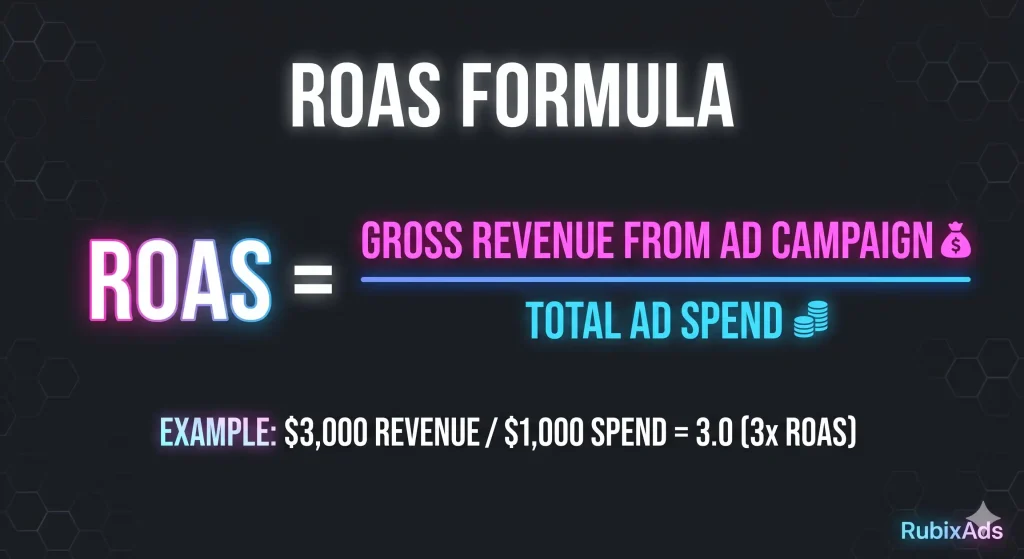
The basic formula for calculating ROAS is straightforward:
ROAS = Revenue Attributable to Ads / Cost of Ads
To see this in action, imagine you run an ad campaign and spend $1,000. That specific campaign generates $3,000 in sales. Using the formula, your ROAS is $3.
You can express this result in three ways:
- As a Ratio (Most Common): 3:1 (You make $3 for every $1 spent).
- As a Percentage: 300% (Multiply your result by 100).
- As a Multiplier: 3x.
The Hidden Trap in ROAS Calculations
Calculating ROAS becomes complicated when you have to define the true “Cost of Ads.” Is it just the money you gave to Google or Facebook? For most startups, the answer is no. To get an accurate picture, you must factor in hidden expenses:
- Agency & Vendor Fees: If an agency charges you a $2,000 retainer to manage a $1,000 ad budget, your true ad cost is $3,000.
- Team Costs: The salary or hourly rate of the in-house marketer setting up and monitoring the campaigns.
These hidden costs often destroy a startup’s true ROAS. If you only track platform spend, you might think you are profitable while actually losing money on management fees.
ROAS vs. ROI: What is the Difference?
While they sound similar, ROAS and ROI (Return on Investment) serve two completely different purposes.
- ROAS measures campaign efficiency. It looks strictly at the revenue generated by specific ads compared to the cost of those ads.
- ROI measures overall business health. It calculates your total net profit against your total net investment (including office rent, software subscriptions, salaries, and shipping costs). The formula is: ROI = (Net Profit / Net Investment) x 100.
It is entirely possible to have a positive ROAS but a negative ROI. For example, your ads might be highly effective at generating sales (High ROAS), but your business expenses and shipping costs are so high that you still lose money overall (Negative ROI).
Use ROAS to optimize your daily marketing campaigns, and use ROI to evaluate long-term business growth.
How to Maximize Your ROAS with RubixAds
Tracking ROAS across multiple channels—Google, Meta, TikTok, and niche platforms—is exhausting. For a startup founder, manually analyzing dashboards to figure out which campaign deserves more budget takes hours of tedious work. Furthermore, hiring a traditional agency introduces massive setup fees that immediately lower your true ROAS.
This is exactly why high-growth startups use RubixAds.
Instead of guessing which platform yields the best return, you can let our autonomous AI marketing system do the heavy lifting. RubixAds analyzes your business and automatically allocates your budget to the channels with the highest predicted ROAS. Our system handles the complex, boring manual execution, launching and optimizing campaigns in real-time.
Because we do not charge upfront agency fees—taking only a small percentage of your ad spend—your costs stay low, and your true ROAS stays exactly where it should be: driving profitable growth for your startup.